AI Passport
A local tool that validates three manually imported AI assessments and turns them into an inspectable fluency profile.
- Manually imported sources
- 3 assessments
- Protocol and history
- Versioned
- Aggregation rules
- Inspectable
The challenge
From observations to an inspectable profile.
Most “AI skill” scores count activity. That measures usage, not effectiveness, and it rewards the wrong evidence.
Product & engineering
What I delivered
An application for turning an assistant’s observations of real collaboration into a private, inspectable AI Fluency profile. Assessments are pasted in by hand, validated, stored and aggregated by explicit rules.
- 01
Import & validation
A versioned response format and manual import. The server checks the methodology version instead of trusting the pasted label.
- 02
Fluency dimensions
Ten AI Fluency dimensions, with INSUFFICIENT_EVIDENCE kept as “no score” rather than a zero.
- 03
Assessment history
Immutable assessment history, methodology versions and a hash of the stored payload.
- 04
Privacy filtering
A privacy guard that drops known raw identifiers. It is a filter, not a guarantee.
- 05
Aggregation rules
Two aggregation rules: a median across sources for AI Fluency, and the strongest-evidence report for a technology claim.
System design
How the pieces connect
- 01
Observations
Assistant context from real collaboration.
- 02
Protocol
Versioned response and server validation.
- 03
History
Immutable assessments and source records.
- 04
Profile
Explicit aggregation and evidence review.
Product interface
- Angular
Services & interfaces
- Spring Boot
Data & search
- PostgreSQL
Platform & delivery
- Flyway
The working context stays with the assistant. A structured response is pasted in, checked, and stored as a versioned assessment. AI Fluency uses the latest compatible report from each source and takes the median. A technology level is not averaged: the report with the highest evidence strength wins, then confidence, then the later date.
Inside the application
The product in practice
- Import assessment
- Review source evidence
- Inspect aggregate
Why it exists
Problem
Usage counts do not show the quality of human–AI collaboration.
My work
Protocol, validation, versioned storage and an inspectable review interface.
Result
Three assessments in a browsable local profile with traceable rules.
How information moves
- 01Assistant context
- 02Structured response
- 03Manual import + validation
- 04Versioned record
- 05Inspectable profile
There is no automatic link to ChatGPT or Cursor. A report only covers the context that assistant could see, and the owner pastes it in by hand.
Real profile snapshot · Methodology ai-fluency-2.3
What the profile currently shows
Assessments reflect each assistant’s available context. They are not an independent skills certification.
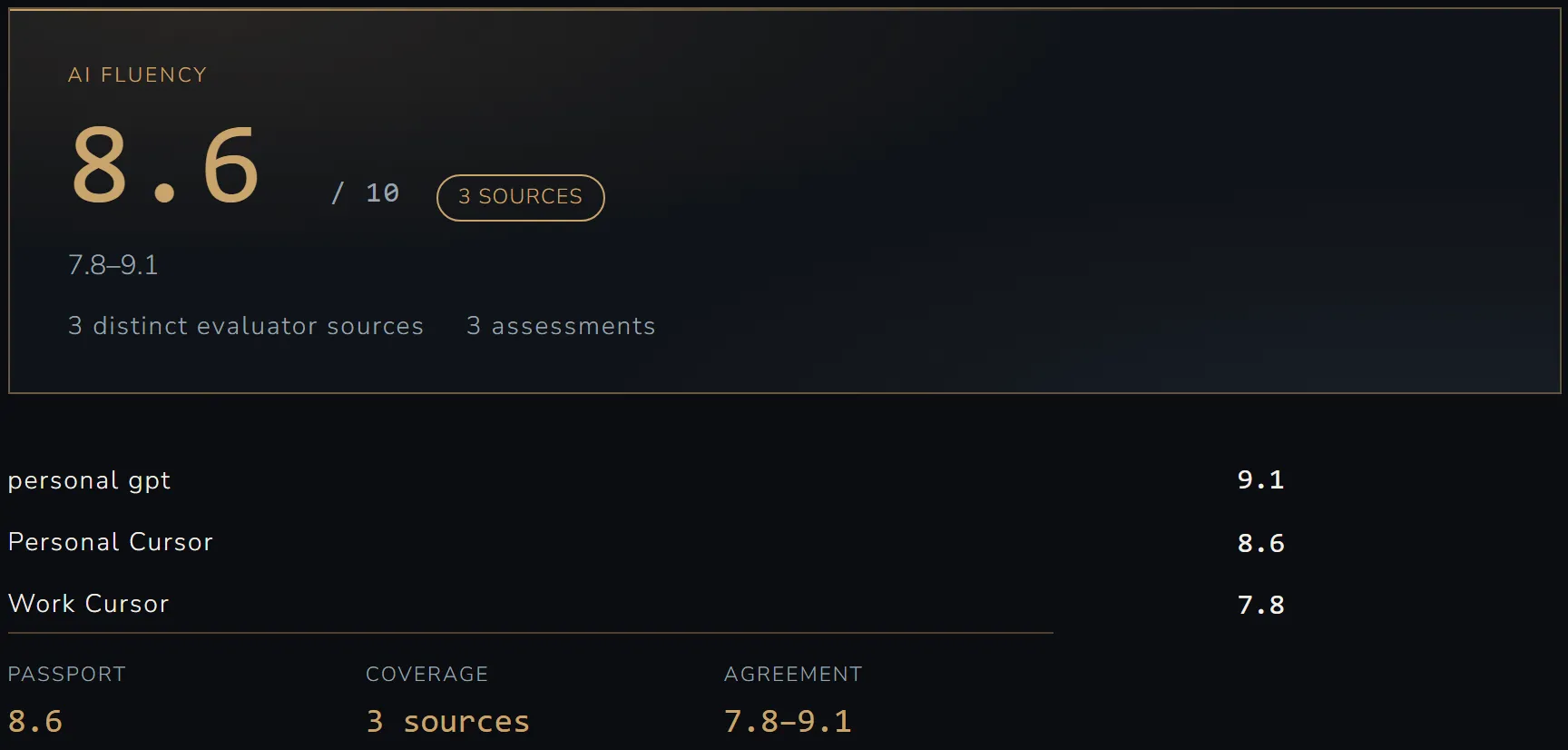
AI Fluency · median across three sources
8.6Range across sources: 7.8–9.1- Work Cursor7.8
- Personal Cursor8.6
- personal gpt9.1
Latest compatible result from each source. Sorted values: 7.8, 8.6, 9.1 → middle value = 8.6. Another source does not add points.
Explore 10 dimensions
- 01Problem Framing8.6
- 02Context Engineering8.4
- 03Task Decomposition8.2
- 04Delegation Discipline8.5
- 05Agent / Tool Orchestration8.3
- 06AI Judgment8.9
- 07Verification Discipline8.8
- 08Autonomy Calibration8.7
- 09Iteration & Recovery8.9
- 10Outcome Ownership8.8
Each figure is the median of the sources that scored that dimension.
Why Java is 8.4 here
Technology claims follow a different rule: evidence strength → confidence → later date.
- personal gptEvidence 5/5Confidence 0.958.4
- Personal CursorEvidence 5/5Confidence 0.887.3
- Work CursorEvidence 3/5Confidence 0.704.5
The two 5/5 reports remain. Confidence 0.95 wins over 0.88, so the selected level is 8.4.
The 4.5 report is not averaged in. It has lower evidence strength for this claim.
Technology reports
Observer labels are kept as written. Amazon Web Services and Amazon Web Services (AWS) stay separate, and so do the two AI agent orchestration names.
- OpenAI APIpersonal gpt2 reports · evidence 5/57.9
- Ollamapersonal gpt2 reports · evidence 4/56.8
- Angularpersonal gpt2 reports · evidence 5/58.0
- Spring Bootpersonal gpt2 reports · evidence 5/58.3
- Cursorpersonal gpt2 reports · evidence 5/59.2
- PostgreSQLpersonal gpt2 reports · evidence 5/57.8
- Dockerpersonal gpt2 reports · evidence 4/57.1
- BaseLinkerpersonal gpt2 reports · evidence 5/57.8
Show all technology reports (64)
Language
- Javapersonal gptevidence 5/58.4
- PythonPersonal Cursorevidence 4/56.4
- SQLPersonal Cursorevidence 4/56.3
- TypeScriptPersonal Cursorevidence 5/57.2
Framework
- Angularpersonal gptevidence 5/58.0
- Spring Bootpersonal gptevidence 5/58.3
- FastAPIPersonal Cursorevidence 3/55.7
- ReactPersonal Cursorevidence 4/56.4
- JPA/HibernatePersonal Cursorevidence 4/56.3
- JHipsterPersonal Cursorevidence 4/56.3
- MicronautWork Cursorevidence 3/54.5
Data
- PostgreSQLpersonal gptevidence 5/57.8
- SQLitePersonal Cursorevidence 3/55.6
Platform
- Cloudflarepersonal gptevidence 5/57.5
- OpenAI APIpersonal gptevidence 5/57.9
- Amazon Web Services (AWS)personal gptevidence 5/57.9
- Amazon EKSpersonal gptevidence 4/57.3
- Microsoft Azurepersonal gptevidence 3/56.7
- BaseLinkerpersonal gptevidence 5/57.8
- Cloudflare R2Personal Cursorevidence 3/55.3
- Model Context ProtocolPersonal Cursorevidence 4/57.2
- VercelPersonal Cursorevidence 4/56.5
- Kong GatewayWork Cursorevidence 4/57.0
- Amazon Web ServicesWork Cursorevidence 4/56.0
- Amazon S3Work Cursorevidence 4/55.5
- Microsoft Entra IDWork Cursorevidence 4/56.5
- Amazon CloudFrontWork Cursorevidence 4/56.0
Tool
- Ollamapersonal gptevidence 4/56.8
- Gradlepersonal gptevidence 3/56.4
- Cursorpersonal gptevidence 5/59.2
- GitLabpersonal gptevidence 4/57.2
- ChatGPTpersonal gptevidence 5/59.3
- Dockerpersonal gptevidence 4/57.1
- FigmaPersonal Cursorevidence 4/56.4
- FlywayPersonal Cursorevidence 4/56.1
- GitPersonal Cursorevidence 5/56.9
- FFmpegPersonal Cursorevidence 3/56.1
- GitLab CI/CDPersonal Cursorevidence 4/56.1
- MavenPersonal Cursorevidence 5/56.6
- JestPersonal Cursorevidence 4/56.1
- PlaywrightPersonal Cursorevidence 5/57.8
- pytestPersonal Cursorevidence 3/55.9
- draw.ioWork Cursorevidence 4/56.5
- PlantUMLWork Cursorevidence 4/55.5
- ViteWork Cursorevidence 3/54.5
- ConfluenceWork Cursorevidence 4/57.5
- TerraformWork Cursorevidence 4/55.5
- GitHub ActionsWork Cursorevidence 4/55.0
- JiraWork Cursorevidence 4/55.5
Domain
- AI Agent Orchestrationpersonal gptevidence 5/58.5
- Retrieval-Augmented Generation (RAG)personal gptevidence 4/57.0
- Browser automationPersonal Cursorevidence 5/57.7
- AI agent orchestrationPersonal Cursorevidence 5/58.7
- Quantitative research systemsPersonal Cursorevidence 4/56.8
- E-commerce systemsPersonal Cursorevidence 5/58.0
- Local generative media pipelinesPersonal Cursorevidence 3/56.4
- UI/UX quality assurancePersonal Cursorevidence 5/58.2
- Privacy-preserving AI evaluationPersonal Cursorevidence 4/57.6
- Application security testingPersonal Cursorevidence 3/55.4
- Software product architecturePersonal Cursorevidence 5/58.1
- AI-Assisted Software DevelopmentWork Cursorevidence 4/57.0
- Software ArchitectureWork Cursorevidence 4/57.5
- Learning TechnologyWork Cursorevidence 4/57.5
- Identity and Access ManagementWork Cursorevidence 4/57.0
What observers recorded
A summary of the observer reports, not facts established by an independent audit.
- Repeatedly frames difficult work in terms of the underlying outcome, operational constraints, failure modes, and acceptance conditions.
- Uses AI as part of multi-stage engineering and research workflows rather than primarily for one-shot answer generation.
Show the other observer notes
- Frequently detects unsupported assumptions, fabricated details, unsuitable approaches, or mismatches with real system behavior and redirects the work.
- Checks important AI-assisted work using execution results, regression cases, source evidence, live-system behavior, quantitative tests, or independent validation.
- Separates architecture, implementation, research, verification, and production concerns and varies AI autonomy according to reversibility and risk.
- Coordinates conversational AI, coding agents, local models, external platforms, files, searches, APIs, and application systems as parts of larger workflows.
What this does not establish
- An answer only reflects the context that assistant could see.
- Evidence and confidence are reported by the observer, not by an outside audit.
- The sources can share history, so agreement is not an independent panel.
- There is no public signup and no visitor API. A technology score does not replace code, experience or an interview.
Implementation notes
Spring Boot, Angular, PostgreSQL, Flyway. Immutable history, versioned rules, a hash of the stored payload, and a privacy guard that drops known raw identifiers. The guard is a filter, not a guarantee.
Outcome & evidence
What the work produced
Delivered outcome
Three manually imported assessments are on the local profile. The AI Fluency median is 8.6, with a source range of 7.8–9.1. This is an inspectable local record, not an independent certification.
Scope & context
An AI report only covers the context that assistant could see. Evidence and confidence are self-reported by the observer. Agreement between sources is not an external exam, and a technology score is not a substitute for code, experience or an interview.