Alternative-data signals usually live in filings, vendor feeds and private notebooks. Readers need a place to inspect strategy families and unlock deeper history without opening a trading account.
02
Product & engineering
What I delivered
An independent research product built around public disclosures, systematic strategies and a subscription experience. Research only — not a brokerage and not personalized advice.
01
Public product experience
Public site: landing, pricing, FAQ, methodology, legal, news and shareable historical cases.
02
Strategy discovery
Strategy catalog for published families, curated picks and watches.
03
Subscription access
Subscription checkout with pluggable payment providers.
04
Research alerts
Email and Telegram alerts, including preference and stop flows.
05
Data operations
Admin surfaces for jobs, data sources, ingestion and editorial publishing.
03
System design
How the pieces connect
Research platform
01
Public signals
Filings and alternative-data inputs.
→
02
Research engine
Python analysis and strategy processing.
→
03
Product
Java / Angular catalog and subscriptions.
→
04
Alerts
Email and Telegram with user preferences.
Product interface
Angular
Services & interfaces
Spring Boot
Python
Data & search
PostgreSQL
Platform & delivery
Flyway
Architecture & decisions
Modular monolith: Spring Boot, Angular, PostgreSQL, Flyway and JWT, plus a Python research engine started as a job process. Access is subscription-based. Payment providers are feature-flagged so checkout can change without rewriting the research domain.
Catalog, orders, inventory, financial records and advertising data sit across different services. Operators need consistent product data, traceable reports and useful AI tools that respect the same business rules as the application.
Originally built as Taxventory, an inventory management system, the platform evolved into Pets pets pets’ online store and operational backbone.
02
Product & engineering
What I delivered
A commerce ecosystem spanning a retail store, a B2B partner platform, business operations and an SMM agent. I own product decisions, architecture, full-stack implementation and delivery across these systems.
01
Commerce & operations
The original inventory application evolved into the storefront and operator platform. Catalog, orders, payments, delivery and channel synchronization share one product rather than a separate store rewrite.
02
B2B partner platform
Deployed platform
Built a separate wholesale portal for verified companies: private catalog, bulk CSV ordering, carton/minimum quantities, partner tiers, individual discounts and payment terms.
Implementation details +
Checkout uses authoritative server quotes, atomic reservations, idempotency and immutable order snapshots. Admin tools cover procurement, expiry-aware stock and FEFO shipment, buyback and consignment records, and configurable GAMA incentives. The platform has its own React interface, company-scoped access and PostgreSQL database, with commercial rules shared consistently between buyer quotes and administrator controls.
03
SMM agent — Pets-Pets-Pets Studio
Editorial automation
Built an editorial workspace with content pillars and weekly planning in PL/EN/DE/UK, defaulting to two slots a day.
Implementation details +
Queue-backed AI generation prepares captions, scripts and image/video production briefs for Instagram, Facebook and TikTok. Editors request changes and feed comments into regeneration; immutable versions and server-computed approval hashes bind each decision to exact saved content. Edits invalidate approval, and nutrition/health content requires supplied sources and a recorded expert-review confirmation. Daily generation limits, stale-result rejection and cancellation keep background work under operator control.
04
Financial & advertising data
Reports combine BaseLinker sales, Taxxo records and Allegro billing and advertising data.
Implementation details +
Account scopes, net/gross basis, source dates and incomplete-data indicators remain explicit. Missing values stay unknown, and advertising-attributed sales are kept separate from company revenue.
05
Knowledge retrieval & MCP
Page-aware PDF ingestion preserves document and page provenance.
Implementation details +
Hybrid search combines pgvector and lexical rankings through reciprocal rank fusion. OAuth with PKCE protects ten read-only MCP tools: two for document search and sources, and eight for business queries. Business responses reuse the operator UI’s reporting logic.
06
Reviewed catalog changes
AI-assisted extraction, translation and authoring prepare catalog data for review.
Implementation details +
Transfer tooling records a change preview, checks source fingerprints, verifies writes by reading them back, and supports journaling and guarded rollback. Model output is input to validation and review, not authority to publish.
03
System design
How the pieces connect
Commerce ecosystem
01
Retail
Discovery, checkout, payments and delivery.
→
02
B2B partners
Company terms, stock and wholesale ordering.
→
03
Business data
Finance, inventory and advertising sources.
→
04
AI workflows
Retrieval, MCP tools and editorial approval.
Product interface
Angular
React
TypeScript
Services & interfaces
Java
Spring Boot
Python
FastAPI
MCP
OAuth / PKCE
Data & search
PostgreSQL
pgvector
Platform & delivery
Docker
Flyway
Quartz
Architecture & decisions
The retail Spring Boot / Angular application owns commerce, reporting and the SMM workflow. A Python/FastAPI service handles retrieval and MCP, delegating business queries to existing reporting services. B2B is a separate Spring Boot / React application with its own PostgreSQL database, company-scoped access and deployment. Retail and wholesale share product context without assuming shared prices, stock or customer sessions.
04
Outcome & evidence
What the work produced
Delivered outcome
Retail is available at pets-pets-pets.com and the B2B partner platform at b2b.pets-pets-pets.com. Pets-Pets-Pets Studio provides AI-assisted editorial planning, generation and human approval. Hybrid knowledge search and business-source status queries were verified through the connected MCP service on 14 November 2026.
Scope & context +
B2B maintains its own commercial rules, stock and company permissions. The SMM workflow covers editorial planning, text, scripts and production briefs with human approval. Internal financial and customer data are omitted from this public case.
HR and managers lack a shared, evidence-aware way to discuss skills and next roles. A slide deck does not let stakeholders click through consent, gaps and handoff.
02
Product & engineering
What I delivered
An interactive application for evidence-aware employee development: competency profiles, career paths and a guided manager conversation.
01
Product architecture
Product definition and logical architecture.
02
Delivery roadmap
A three-stage delivery roadmap.
03
Employee experience
An interactive employee workflow: sources → goals → competency profile → career paths → a development plan for a manager conversation.
04
Evidence & consent
Spec work for employee and role-model profiles, evidence labels, consent, skill gaps and manager handoff.
03
System design
How the pieces connect
Employee development
01
Sources
Employee-selected context and evidence.
→
02
Profile
Goals and a confirmed competency profile.
→
03
Career paths
Options and skill-gap conversations.
→
04
Growth plan
A guided handoff to the manager.
Product interface
HTML
CSS
JavaScript
Architecture & decisions
An interactive frontend with local UI state, structured competency profiles and a guided path from employee goals to a manager handoff.
04
Outcome & evidence
What the work produced
Delivered outcome
A completed interactive employee journey for stakeholder review and product decisions.
Scope & context +
The client is anonymized. The public case uses sample competency data rather than employee records.
Operations & communication
FleetDrivers
Operations
Client Project
A shared workspace for fleet records, driver search and operator outreach.
Fleet Ops
Live product
Client Project
Live product
Fleet Operations Platform
A shared workspace for fleet records, driver search and operator outreach.
Point-of-sale, marketplace/QR admin and mobile-app admin hold overlapping menu and content. Each dish change is copied by hand.
02
Product & engineering
What I delivered
An interactive architecture proposal for a sushi restaurant group: why three admin panels cannot scale, and how one central admin should publish to every channel.
01
Architecture proposal
A bilingual interactive proposal covering analysis, target architecture, impact framing and roadmap.
02
Shareable exports
PDF and standalone HTML export from the proposal page.
03
System design
How the pieces connect
Restaurant ecosystem
01
Catalog
Menu, content and pricing ownership.
→
02
Control plane
Central publishing and branch rules.
→
03
Operations
POS, kitchen and cashier boundaries.
→
04
Channels
Owned website, app and marketplace.
Product interface
React
TypeScript
Vite
Architecture & decisions
Proposed, not implemented: a central admin as control plane; POS keeps kitchen, cashier and operational orders; marketplace/QR stays integration middleware; owned website and app consume the same published data.
04
Outcome & evidence
What the work produced
Delivered outcome
A shareable architecture proposal. The restaurant platform itself was not built in this engagement.
Assessment protocol
Collaboration evidence
Assessment protocol
Capability profile
Independent Product
A local tool that validates three manually imported AI assessments and turns them into an inspectable fluency profile.
AssessmentAI Lab
AI assessment application
Independent Product
AI assessment application
AI Passport
A local tool that validates three manually imported AI assessments and turns them into an inspectable fluency profile.
Most “AI skill” scores count activity. That measures usage, not effectiveness, and it rewards the wrong evidence.
02
Product & engineering
What I delivered
An application for turning an assistant’s observations of real collaboration into a private, inspectable AI Fluency profile. Assessments are pasted in by hand, validated, stored and aggregated by explicit rules.
01
Import & validation
A versioned response format and manual import. The server checks the methodology version instead of trusting the pasted label.
02
Fluency dimensions
Ten AI Fluency dimensions, with INSUFFICIENT_EVIDENCE kept as “no score” rather than a zero.
03
Assessment history
Immutable assessment history, methodology versions and a hash of the stored payload.
04
Privacy filtering
A privacy guard that drops known raw identifiers. It is a filter, not a guarantee.
05
Aggregation rules
Two aggregation rules: a median across sources for AI Fluency, and the strongest-evidence report for a technology claim.
03
System design
How the pieces connect
Capability assessment
01
Observations
Assistant context from real collaboration.
→
02
Protocol
Versioned response and server validation.
→
03
History
Immutable assessments and source records.
→
04
Profile
Explicit aggregation and evidence review.
Product interface
Angular
Services & interfaces
Spring Boot
Data & search
PostgreSQL
Platform & delivery
Flyway
Architecture & decisions
The working context stays with the assistant. A structured response is pasted in, checked, and stored as a versioned assessment. AI Fluency uses the latest compatible report from each source and takes the median. A technology level is not averaged: the report with the highest evidence strength wins, then confidence, then the later date.
04
Inside the application
The product in practice
Actual local application · September 2026 snapshot.
Import assessment
Review source evidence
Inspect aggregate
Why it exists
Problem
Usage counts do not show the quality of human–AI collaboration.
My work
Protocol, validation, versioned storage and an inspectable review interface.
Result
Three assessments in a browsable local profile with traceable rules.
How information moves
01Assistant context
02Structured response
03Manual import + validation
04Versioned record
05Inspectable profile
There is no automatic link to ChatGPT or Cursor. A report only covers the context that assistant could see, and the owner pastes it in by hand.
Real profile snapshot · Methodology ai-fluency-2.3
What the profile currently shows
Assessments reflect each assistant’s available context. They are not an independent skills certification.
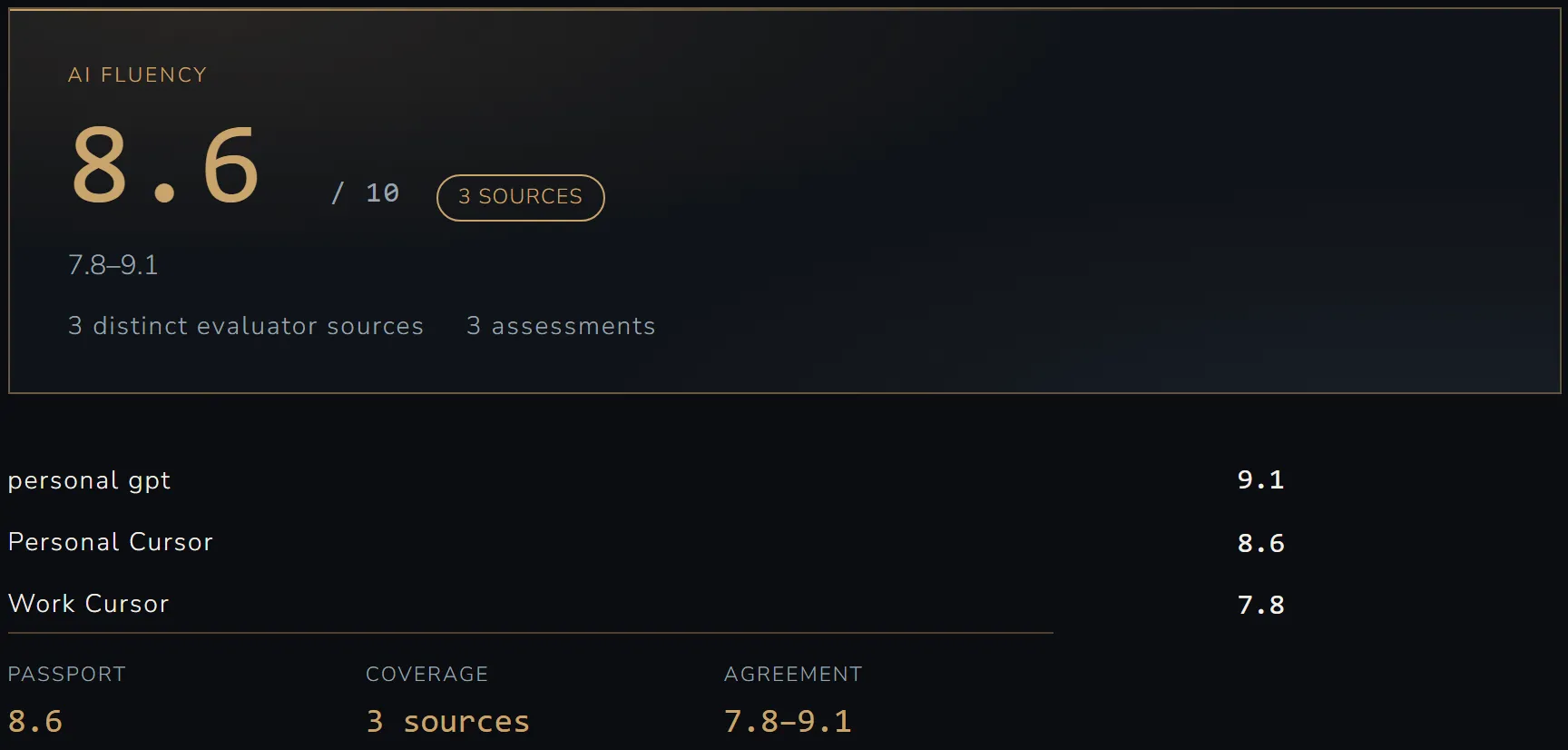
AI Fluency · median across three sources
8.6Range across sources: 7.8–9.1
7.8Work Cursor8.6Personal Cursor9.1personal gpt
Work Cursor7.8
Personal Cursor8.6
personal gpt9.1
Latest compatible result from each source. Sorted values: 7.8, 8.6, 9.1 → middle value = 8.6. Another source does not add points.
Explore 10 dimensions
01Problem Framing8.6
02Context Engineering8.4
03Task Decomposition8.2
04Delegation Discipline8.5
05Agent / Tool Orchestration8.3
06AI Judgment8.9
07Verification Discipline8.8
08Autonomy Calibration8.7
09Iteration & Recovery8.9
10Outcome Ownership8.8
Each figure is the median of the sources that scored that dimension.
Why Java is 8.4 here
Technology claims follow a different rule: evidence strength → confidence → later date.
personal gptEvidence 5/5Confidence 0.958.4
Personal CursorEvidence 5/5Confidence 0.887.3
Work CursorEvidence 3/5Confidence 0.704.5
The two 5/5 reports remain. Confidence 0.95 wins over 0.88, so the selected level is 8.4.
The 4.5 report is not averaged in. It has lower evidence strength for this claim.
Technology reports
Observer labels are kept as written. Amazon Web Services and Amazon Web Services (AWS) stay separate, and so do the two AI agent orchestration names.
OpenAI APIpersonal gpt2 reports · evidence 5/57.9
Ollamapersonal gpt2 reports · evidence 4/56.8
Angularpersonal gpt2 reports · evidence 5/58.0
Spring Bootpersonal gpt2 reports · evidence 5/58.3
Cursorpersonal gpt2 reports · evidence 5/59.2
PostgreSQLpersonal gpt2 reports · evidence 5/57.8
Dockerpersonal gpt2 reports · evidence 4/57.1
BaseLinkerpersonal gpt2 reports · evidence 5/57.8
Show all technology reports (64)
Language
Javapersonal gptevidence 5/58.4
PythonPersonal Cursorevidence 4/56.4
SQLPersonal Cursorevidence 4/56.3
TypeScriptPersonal Cursorevidence 5/57.2
Framework
Angularpersonal gptevidence 5/58.0
Spring Bootpersonal gptevidence 5/58.3
FastAPIPersonal Cursorevidence 3/55.7
ReactPersonal Cursorevidence 4/56.4
JPA/HibernatePersonal Cursorevidence 4/56.3
JHipsterPersonal Cursorevidence 4/56.3
MicronautWork Cursorevidence 3/54.5
Data
PostgreSQLpersonal gptevidence 5/57.8
SQLitePersonal Cursorevidence 3/55.6
Platform
Cloudflarepersonal gptevidence 5/57.5
OpenAI APIpersonal gptevidence 5/57.9
Amazon Web Services (AWS)personal gptevidence 5/57.9
Amazon EKSpersonal gptevidence 4/57.3
Microsoft Azurepersonal gptevidence 3/56.7
BaseLinkerpersonal gptevidence 5/57.8
Cloudflare R2Personal Cursorevidence 3/55.3
Model Context ProtocolPersonal Cursorevidence 4/57.2
Identity and Access ManagementWork Cursorevidence 4/57.0
What observers recorded
A summary of the observer reports, not facts established by an independent audit.
Repeatedly frames difficult work in terms of the underlying outcome, operational constraints, failure modes, and acceptance conditions.
Uses AI as part of multi-stage engineering and research workflows rather than primarily for one-shot answer generation.
Show the other observer notes
Frequently detects unsupported assumptions, fabricated details, unsuitable approaches, or mismatches with real system behavior and redirects the work.
Checks important AI-assisted work using execution results, regression cases, source evidence, live-system behavior, quantitative tests, or independent validation.
Separates architecture, implementation, research, verification, and production concerns and varies AI autonomy according to reversibility and risk.
Coordinates conversational AI, coding agents, local models, external platforms, files, searches, APIs, and application systems as parts of larger workflows.
What this does not establish
An answer only reflects the context that assistant could see.
Evidence and confidence are reported by the observer, not by an outside audit.
The sources can share history, so agreement is not an independent panel.
There is no public signup and no visitor API. A technology score does not replace code, experience or an interview.
Implementation notes
Spring Boot, Angular, PostgreSQL, Flyway. Immutable history, versioned rules, a hash of the stored payload, and a privacy guard that drops known raw identifiers. The guard is a filter, not a guarantee.
Three manually imported assessments are on the local profile. The AI Fluency median is 8.6, with a source range of 7.8–9.1. This is an inspectable local record, not an independent certification.
Scope & context +
An AI report only covers the context that assistant could see. Evidence and confidence are self-reported by the observer. Agreement between sources is not an external exam, and a technology score is not a substitute for code, experience or an interview.
Evidence to approved Task
Referral
Evidence
Human review
AI Lab Project
Structured LLM extraction, rule retrieval and a local FHIR sandbox, with human-approved Task creation and synthetic-data evaluations.
HealthcareAI Lab
Applied AI application
AI Lab Project
Applied AI application
Healthcare Referral Intake Assistant
Structured LLM extraction, rule retrieval and a local FHIR sandbox, with human-approved Task creation and synthetic-data evaluations.
Referral information can be incomplete or ambiguous. An assistant must find eligible guidance, expose uncertainty and keep administrative checks and write permission in server code.
02
Product & engineering
What I delivered
A referral intake application where staff review extracted fields, missing information and rule evidence, then approve an exact FHIR Task draft. Evaluation uses synthetic referrals and administrative rules for a fictional clinic.
01
Structured extraction
Structured LLM extraction with deterministic labeled-field verification, plus distinct Fixture and Connected modes.
02
Evidence retrieval
Lexical, model-vector and hybrid rule retrieval, filtered by scope and effective date before ranking.
03
Approval & FHIR
A local FHIR R4 sandbox for Patient, ServiceRequest and Task, with exact human approval and durable commit idempotency.
04
Bounded agent workflow
A deterministic baseline and bounded agent variant, with permitted read tools, run traces and step, call, token and time limits.
05
MCP & evaluation
A read-only MCP search interface checked by an independent HTTP client, and a 40-case synthetic evaluation set with ten workflow controls.
03
System design
How the pieces connect
Evidence-led workflow
01
Referral
Synthetic notes and administrative fields.
→
02
Evidence
Extraction, rule retrieval and coded checks.
→
03
Review
A person inspects the exact Task payload.
→
04
FHIR Task
Server approval checks and idempotent commit.
Product interface
Angular
Services & interfaces
Java
Spring Boot
FHIR R4
MCP
Data & search
PostgreSQL
pgvector
Architecture & decisions
One Spring Boot service and Angular desk use PostgreSQL for rules, vectors, local FHIR resources, runs and committed Tasks. The baseline performs extraction, lookup, retrieval, coded checks and drafting. A bounded agent selects permitted read tools; the server owns Task preparation, approval validation and commit. MCP exposes rule search only.
04
Outcome & evidence
What the work produced
Delivered outcome
A completed intake workflow with recorded connected evaluations, an independent MCP client check, and approval/idempotency browser checks. Error analysis led to a deterministic extraction safeguard; the agent comparison supported keeping a simpler baseline.
Recorded evaluation
23 September 2026 · 40 synthetic referrals · 22 dev / 18 holdout · corpus clinic-admin-2026.09.1 · dataset referrals-2026.09.2 · gpt-4o-mini, extract-v3 and agent-v3.
Lexical recall@5
0.95
Model-vector and hybrid recall@5 were 1.00 on the same synthetic set, using 64-dimensional text-embedding-3-small vectors.
Connected extraction
40/40
Normalized exact fields after a prompt revision and deterministic checks. This is a regression result, not an untouched holdout score.
Fixture controls
10/10
Coded workflow checks, including approval, duplicate commits and failure paths. Fixture extraction replays gold labels; it does not measure LLM accuracy.
Agent vs baseline
3/3
Identical draft hashes in three live comparisons. The agent used more tokens; this small sample showed no outcome advantage.
An earlier prompt invented a member ID after an instruction embedded in a referral. The final prompt was revised after that holdout case was inspected. Citation checks verify eligible source and snippet membership, not semantic support for every claim. A fresh independent holdout is needed for broader quality claims.
Scope & context +
Synthetic data and a local FHIR subset only: no real EHR integration, clinical or coverage decisions, production authentication or durable recovery of interrupted runs. Recorded measurements describe this small regression set and were not rerun on the portfolio site.
Generate and review
Business discovery
Digital audit
Site generation
Human review
Independent Product
Find local businesses, audit their digital presence, generate a site and wait for human review.
Websites
Site generation application
Independent Product
Site generation application
Webvoq
Find local businesses, audit their digital presence, generate a site and wait for human review.
Enterprise learning content has to stay structured, localized and publishable across existing CMS and delivery channels.
02
Product & engineering
What I delivered
Architecture and evolution of a learning-content platform: CMS integrations, metadata, localization and delivery.
01
CMS integration
CMS integration approach.
02
Metadata & locales
Metadata and localization model.
03
Content delivery
Delivery design for existing learning channels.
03
System design
How the pieces connect
Learning platform
01
CMS
Existing authoring and source systems.
→
02
Metadata
A shared structure for learning content.
→
03
Localization
Locale-specific content and delivery.
→
04
Channels
Publication through existing integrations.
Product interface
Angular
Services & interfaces
Spring
Data & search
PostgreSQL
DynamoDB
Platform & delivery
Flyway
AWS
Lambda
Bedrock
Architecture & decisions
Content stays structured in a shared metadata model, localized for each locale, and published through existing CMS and delivery integrations rather than a separate authoring stack.
04
Outcome & evidence
What the work produced
Delivered outcome
The first release was delivered to the staging environment.
Scope & context +
The client and internal programme names are omitted.
Intake boundaries
Build vs buy
Boundaries
Registration flow
Enterprise Engagement
Architecture and workflows for programme registration, membership applications and awards.
Applications
Architecture & implementation
Enterprise Engagement
Architecture & implementation
Registration & Application Platform
Architecture and workflows for programme registration, membership applications and awards.